
Happy Kombucha brewing guide
How to Look After Your Milk Kefir Grains
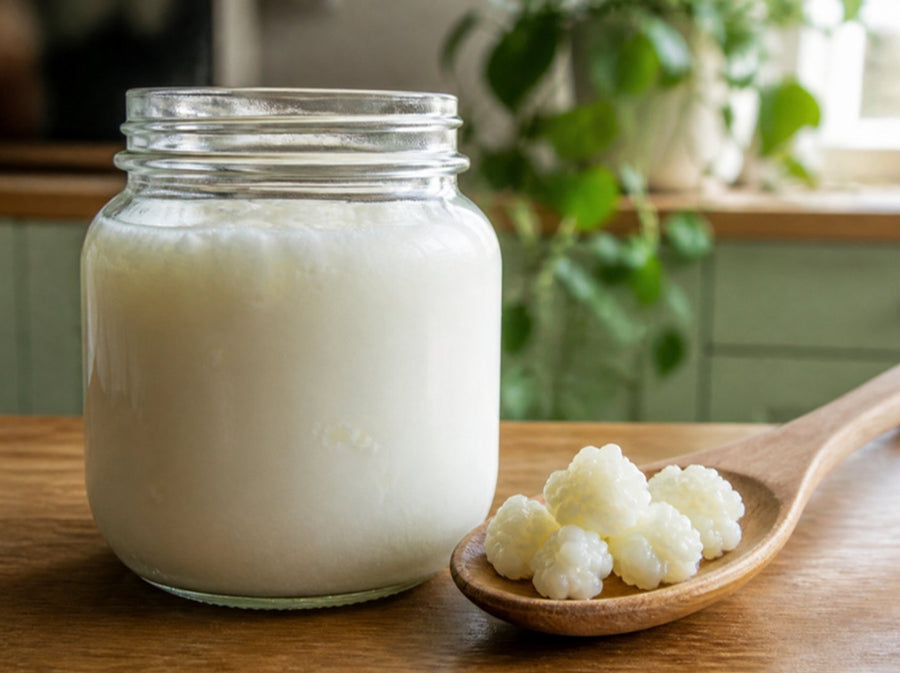
Milk kefir grains are a living culture of bacteria and yeast that turn ordinary milk into thick, tangy, naturally probiotic kefir. Your grains have travelled to you, so they need a little time to wake up and settle in. Read these instructions through before you start, and get in touch if you're unsure about anything.
At a glance
| Stage | Milk | Grains | Time | Look for |
|---|---|---|---|---|
| Activation | 250ml | 1 sachet (about 5g) | Up to 48 hours | The milk thickens and starts to separate |
| Settling in (1–3 weeks) | 250ml | All your grains | 24–48 hours | Watery or very sour kefir is normal at first |
| Every batch after | 250ml | About 5g | 24–48 hours | The thickness of single cream |
| Bigger batches | 1 litre | About 1 tbsp (15g) | 24–48 hours | Only once your grains have grown |
Keep your grains at 18–22°C, including overnight. Below 18°C they're slow to settle, and this is the most common reason for a slow start. A stick-on thermometer on your jar makes it easy to check. Never leave your jar in direct sunlight, and never rinse or wash your grains.
Before you begin
Start straight away
Get your grains into milk as soon as they arrive. If you can't, keep them in the fridge and activate them before the use-by date on the packet.
Don't rinse your grains
They grow a natural protective coating (kefiran). Rinsing it off as a routine weakens them and makes them more prone to mould.
Keep cultures apart
Keep different cultures at least 1 metre apart, ideally in separate rooms, to stop cross-contamination. This matters most with dairy.
Metal, but only briefly: a good stainless steel sieve or spoon is fine for straining, but keep contact short and never leave metal sitting in kefir. Don't use anything showing signs of rust.
Wash and rinse your jar and utensils well. They don't need sterilising.
What you'll need
- Your milk kefir grains
- Milk: 250ml per sachet of grains. Organic cow's or goat's milk works best (see choosing your milk).
- A glass jar, such as our 1 litre glass jar
- A sieve or strainer: plastic, like our plastic sieve, or good stainless steel
- A lid, cloth or paper cover, and an elastic band
- A spoon, jug and bowl
- Bottles or a jar for your finished kefir, such as our 500ml glass milk bottles
Starting from scratch? Our milk kefir starter kit has everything you need in one go.
Activating your grains
-
Add your grains and milk
Put your grains into a clean glass jar and pour in 250ml of milk per sachet (about 5g) of grains.
-
Cover it
Cover the jar with a lid, cloth or paper cover and secure it with an elastic band.
-
Leave it to work
Leave it at room temperature (18–22°C), out of direct sunlight, for up to 48 hours. Check it after 24 hours. You're waiting for the milk to thicken and start to separate. In winter it can take longer, and that's normal.
-
Stir it well
Once it starts to separate, stir it really well until you can't see any separation. You can't damage the grains by stirring hard.
-
Strain and bottle
Strain out the grains, stirring the kefir in the sieve to help it through, then bottle your kefir. Your grains are now activated!
No separation after 48 hours? Strain the grains into fresh milk and try again. Don't leave them in the same milk much longer than 48 hours.
What to expect while they settle in
- Your grains are recovering from their journey, so the first week or two of kefir is often very watery or very sour. It's still fine to drink.
- You may get a crust on top around the grains, with only about a third of the milk thickening and the rest watery underneath. This is normal at the start.
- It can split and separate very quickly in the first few weeks. Just stir it well.
- Kept above 18°C, most grains settle in after 3 to 5 brews. It can take up to 2 weeks, and great-tasting kefir usually comes within 1 to 3 weeks.
Not working after 2 weeks? Don't throw it away. Cover it, put it in the fridge and contact us. We promise your grains will work. Sometimes they just need a little patience at the beginning.
Your daily routine

-
Strain and refill
Strain your kefir and put about 5g of grains back into a clean jar with 250ml of fresh milk.
-
Leave it 24–48 hours
Cover and leave at room temperature for 24 to 48 hours, depending on how warm your home is.
-
Check the thickness
It's ready when it's the thickness of single cream. Kefir never gets as thick as yoghurt.
-
Bottle and start again
Strain, bottle and chill your kefir, then start again with fresh milk.

Not ready or ready? On the left, it still looks like milk, so give it longer. On the right, it has thickened and is just starting to separate, so strain it now. If you see lots of watery whey, it has gone a little too long. Just shake it back together and strain sooner next time.
Grains are living, so they need regular fresh milk. Keep this routine going every 24 to 48 hours.
Open or closed brewing?

Open brewing (cloth or paper cover)
- Gas can escape, so your kefir is milder and less fizzy.
- The cover keeps fruit flies and dust out.
- The easiest way to start.
Closed brewing (lid on)
- The gas stays in, so your kefir is fizzier, slightly more yeasty, and can be a little thicker.
- Loosen the lid now and then to release the pressure.
- Leave some space at the top of the jar.
Both work. Try each and see which kefir you prefer.
Flavouring and second fermenting
Plain kefir is lovely, but a little flavour is a great way to get the whole family drinking it. There are three easy ways to do it.
1. Second ferment with peel (lighter, creamier, a little fizzy)
-
Strain your kefir
Make your kefir as normal and take out the grains.
-
Add the peel
Put the kefir in a jar with a lid. Peel strips of zest from a lemon or orange and add them. Use unwaxed or organic fruit, or dip it in boiling water for 30 seconds and rinse it in cold water first.
-
Leave it 4 to 12 hours
Seal the jar and leave it at room temperature for 4 to 12 hours, or up to a day. A little separation is fine.
-
Chill and enjoy
Move it to the fridge. It'll be lighter, creamier and slightly fizzy, and a second ferment also mellows the sourness.
A vanilla pod or a few blueberries work well too. Keep it simple.
2. Infuse in the fridge (for non-sweet flavours)
Pop the flavouring into the bottle you keep your kefir in, stir, and leave it in the fridge. The longer you leave it, the stronger the flavour. Try cinnamon, a vanilla pod, star anise, or lemon, lime or orange zest. For a savoury kefir to use as a salad dressing, try garlic and rosemary.
Avoid adding sugary things to a second ferment. The grains' bacteria and yeasts feed on the sugar, and your kefir can end up very sour.
3. Blend and drink straight away (for fruity kefir)
Fruit, jam and honey contain sugar, so blend them in just before drinking. Use the pulse setting so the blender doesn't heat the kefir.
Strawberry
250ml kefir and 2 tablespoons of strawberry jam (or any jam you like).
Peanut butter and banana
250ml kefir, 1 tablespoon of peanut butter and a quarter of a banana, fresh or frozen.
Blackberry pie
250ml kefir, 2 tablespoons of blackberry jam, ½ teaspoon of cinnamon and 1 tablespoon of porridge oats.
Orange and vanilla
250ml kefir, 2½ tablespoons of orange juice, ¼ teaspoon of vanilla extract and a cup of ice.
Any frozen fruit
250ml kefir with about a quarter of a cup of frozen fruit. Soft bananas are great frozen and used up this way.
Smoothie
Mix your kefir half and half with a fruit or veg smoothie, shop-bought or homemade.
You can also freeze kefir into ice lollies or make kefir ice cream. See our flavouring milk kefir blog for the recipes.
What milk to use
Milk is your grains' food. They feed on the lactose (milk sugar), so the milk you choose affects how well they grow and how your kefir tastes.
| Milk | Use it? | Notes |
|---|---|---|
| Whole cow's or goat's milk | Best choice | Thick, creamy kefir. Organic is best, but not essential. Some people believe antibiotic traces in non-organic milk can harm the grains. Using goat's milk? Try our goat's milk kefir grains. |
| Semi-skimmed or skimmed | Yes | The kefir is thinner and can be "bitty". The fat content decides how thick your kefir is. |
| Sheep, camel or buffalo milk | Yes | All work well. |
| Raw (unpasteurised) milk | Yes, if you can safely drink it | We recommend it if you can get hold of it. See the note below. We also sell grains grown in raw milk. |
| Homogenised or unhomogenised | Both | A personal choice. See below. |
| Cream | Yes, as an extra | Add some to your milk if you'd like thicker kefir. |
| UHT or long-life milk | Emergencies only | Fine for the odd batch if you run out of fresh milk. |
| Lactose-free milk | Avoid | Your grains feed on lactose, so lactose-free milk leaves them hungry. |
| Plant milks (oat, soy, coconut, almond) | Now and then | They have no lactose, so your grains need to go back into dairy milk regularly to stay healthy. See brewing with nut and plant milks. |
| Flavoured or sweetened milk | Avoid | Add flavours after brewing instead. |
Homogenised or unhomogenised? Both work, so it's really down to personal preference. Your grains find it slightly easier to get at the fat in homogenised milk. Unhomogenised (cream-top) milk is our own favourite for a more traditional kefir.
About raw milk: raw milk can carry harmful bacteria. It isn't recommended for pregnant women, babies and young children, older people, or anyone with a weakened immune system. Only buy raw milk from a registered producer, and keep it chilled.
Experiment with different milks to find the kefir you enjoy most.
Finding it too sour? Homemade kefir has far more live bacteria than shop-bought, so it's much tangier. A second ferment mellows the taste.
Brewing with nut and plant milks
You can use your milk kefir grains to make kefir from coconut, almond, soya, oat and other plant milks. It's a lovely change, and handy if you're cutting down on dairy. The one thing to remember is that your grains feed on lactose, the natural sugar in animal milk, and plant milks don't have any. So your grains need regular trips back into dairy milk to stay healthy.
-
Let your grains settle in first
Brew in full-fat cow's or goat's milk for at least the first few weeks, until your grains are making good, thick kefir every day. Switching milks while they're still settling in can set them back. Dried grains must be fully rehydrated and active in dairy milk first.
-
Brew in your plant milk
Put the grains in your plant milk, stir gently, cover with a breathable cloth and leave at room temperature. Start checking after 12 hours. Plant milk kefir usually takes 12 to 48 hours.
-
Strain and repeat
Strain out the grains as usual. You can do 2 or 3 brews in a row in plant milk.
-
Give them a dairy day
After every 2 or 3 plant milk brews, put the grains back into full-fat dairy milk for 24 hours so they can feed. If they stay in plant milk all the time, they'll slowly starve and stop working.
What to expect
- The first batch may not work. Grains often need an adjustment period when they change milk. If the first batch doesn't thicken or sour, use that milk for cooking and try again with fresh plant milk.
- It's usually thinner. Plant milk kefir is often thinner than dairy kefir, and it can separate. Give it a good stir or shake.
- The taste is different. Expect it to be tangier, and sometimes a little yeasty or fizzy.
- Your grains won't grow. Grains only grow in dairy milk, so don't worry if they stay the same size, or shrink a little, during plant milk brews.
- Coconut milk works especially well, and makes a rich, creamy kefir. Soya and almond milk are popular too.
Choosing a plant milk
- Fresh homemade, tinned or boxed plant milk all work.
- Choose plain, unsweetened milk with as few additives as possible. Some additives can be hard on your grains.
- Homemade nut milk goes off faster, so make it fresh and use it within a day or two.
Vegan or completely dairy-free? Milk kefir grains live in dairy milk, so kefir made with them will always contain a little dairy. For a completely dairy-free kefir, you can use a few spoonfuls of water kefir as a starter instead. See option 3 in our coconut, almond and soya milk kefir post.
Read more: Making coconut, almond and soya milk kefir · How to make almond milk kefir · How to make coconut milk kefir
Looking after your grains
Your grains are a little self-contained ecosystem. Keep them fed, warm enough and with the right amount of milk, and they'll look after themselves and keep making kefir for years.
Keep the ratio right
- Aim for about 1 heaped teaspoon (5g) of grains to 250ml of milk. Once your grains have settled, that's usually ready in about 24 hours.
- Your grains grow as you brew, and the more grains you have, the faster they ferment the milk. Add more milk as they grow (about 1 tablespoon, or 15g, of grains per litre).
- Only keep as many grains as you need for the kefir you drink. More grains means more milk, and you'll soon be making more kefir than you can drink.
Signs you have too many grains
- Your kefir is ready much faster than usual (although a very warm room can do this too).
- It's very sour, with thick, hard curds that are difficult to strain.
- It's a little slimy or jelly-like.
What to do
- Take some grains out, back to about 1 heaped teaspoon per 250ml.
- Keep some spares as back-ups, just in case. We recommend freezing some and drying some (see storing, freezing and drying).
- Share them with friends, or start a second jar.
What to do with spare grains
- Share them with friends and family.
- Use them to start a sourdough starter or to make a soft cheese like cottage cheese.
- Use them to ferment vegetables or vegetable juices such as carrot or beetroot. The grains won't survive this, so only use spares.
- Compost them, a few at a time. Too many at once can change the pH of your soil.
Washing your jar
There are lots of opinions on this. Our favourite: keep re-using the same jar between batches without rinsing, and give it a good clean every week or so. If you use washing-up liquid or vinegar, rinse the jar really well afterwards, and let a hot jar cool completely before your grains go back in.
Rinsing your grains
Don't rinse your grains as a routine. They coat themselves in a sticky, slimy goo that protects them, and washing it off can weaken them. The only time to rinse them is when you starve them (below), and always in unchlorinated water: boiled and cooled, or filtered.
Starving your grains (every 3 to 6 months)
Over time your grains can pick up stray bacteria from your kitchen, and your kefir can start to taste "off". You probably haven't harmed your grains. Starving them rebalances them.
-
Rinse them
Gently rinse the grains in unchlorinated water (boiled and cooled, or filtered), moving them around to clean them off.
-
Put them in water
Put them in a jar or glass with about 200ml of unchlorinated or filtered water, and cover with a cloth as normal.
-
Leave them for 24 to 48 hours
We usually go for 24 to 36 hours.
-
Back into milk
Strain them and put them back into fresh milk. Brew as normal.
Keep cultures apart: keep your kefir at least 1 metre away from other cultures, ideally in a different room, to stop them cross-contaminating.
Storing, freezing and drying your grains
Need a break from brewing? Choose the method that fits how long you'll be away. Whichever you use, never rinse your grains first. Just pat them dry with kitchen paper.

| Method | How long | Waking them up |
|---|---|---|
| Fridge | 2 to 3 weeks at a time | 1 or 2 batches |
| Freezer | Up to about 2 months | Several weak batches |
| Dried | Up to about 6 months | About 1 to 2 weeks, like new grains |
In the fridge
- Put your grains in fresh milk (your usual amount), seal the jar with a lid and keep it in the fridge for up to 2 to 3 weeks. Don't use a cloth cover in the fridge.
- Away for longer? Change the milk every 2 to 3 weeks.
- When you're back, strain them into fresh milk at room temperature. They may need 1 or 2 batches to get going again.
In the freezer
- Pat the grains dry with kitchen paper.
- Coat them in a little dried milk powder. This protects them from freezer burn. It isn't essential, but your grains will keep much better with it.
- Freeze in a sealed bag or pot for up to about 2 months.
- To revive them, thaw them in the fridge, then put them in fresh milk. Expect several weak batches before they're back to normal.
Drying (dehydrating)
- Pat the grains dry with kitchen paper.
- Spread them out on paper or a plate and leave them at room temperature, out of direct sunlight, for 3 to 5 days, until they're hard and yellowish.
- Store them in a sealed bag in the fridge for up to about 6 months. A little milk powder in the bag helps them keep.
- To revive them, follow the same steps as activating new grains. It may take a week or two before they're brewing well.
Want a back-up you don't have to dry yourself? Our dehydrated milk kefir grains keep for months and come with their own activation instructions.
How much kefir to drink
Homemade kefir is packed with live bacteria and yeasts, far more than shop-bought, so start slowly and let your body adjust. Everyone is different, so listen to your body.

-
Start small
Have a spoonful up to a shot-sized glass a day, first thing in the morning or last thing at night, on an empty stomach.
-
Stay there for a week
Keep to the same amount for about 7 days. If you get any side effects, cut back until they settle.
-
Then double it
Once you've had 7 days with no side effects, double the amount and stay there for another week.
-
Keep building up
Repeat until you're having about ½ to 1 pint a day without any side effects.
This is also why we don't send lots of grains to start with: your kefir supply grows as your grains do, in step with your body getting used to it. Some people like to have kefir 5 days out of 7 and take a couple of days off.
Possible side effects
Some people get wind, bloating, cramps or changes in toilet habits at first. How much depends on the state of your gut before you started. Cutting back on kefir usually stops them.
Good to know: kefir is a fermented drink, so it contains a little alcohol. In milk kefir it's only trace amounts, but bear it in mind if you're sensitive to alcohol or giving kefir to children. Check with your doctor first if you're pregnant, have a weakened immune system or take regular medication.
Is it mould?
Normal
- A thick crust or creamy layer on top.
- Curds and watery whey (it's over-fermented, just stir it).
- A yeasty, sour or slightly cheesy smell.
- Soft, slimy, creamy-white or slightly yellow grains.
Mould
- Fuzzy, furry spots on the surface or the grains.
- Pink, orange, green, blue or black patches.
- If you're not sure, treat it as mould.
Mould is more likely if grains are rinsed often, left in direct sunlight, left too long without fresh milk, or kept too close to other cultures.
Think it's mould? First check our Culture Clinic and Help Hub.
Bought the grains from us recently and want a replacement? Don't throw them away. Cover the jar, don't drink it, and send us a photo so we can see it and help. We can't replace grains that have already been thrown away.
Otherwise, if it's mould, throw away the kefir and the grains, wash everything in hot soapy water and start again.
Troubleshooting
Answer a couple of quick questions to find out what's going on.
Quick checks
Normal
- Watery or very sour kefir in the first 1 to 3 weeks, while the grains settle in.
- A crust on top with watery milk underneath at the start. Just stir it well.
- Kefir splitting into curds and whey. Stir it well before straining.
- Grains taking up to 2 weeks to brew properly, especially in winter.
Taste and timing
- Too sour: strain it sooner, or add more milk next time. A second fermentation also mellows it.
- Too thin or not thickening: normal for the first 2 to 3 weeks. Keep going with fresh milk every 24 to 48 hours.
- Slow to ferment: check it stays above 18°C, even overnight. This is the most common cause.
Frequently asked questions
I've left my new grains in milk for 24 hours and nothing has happened. Are they dead?
No, they're just settling in. The journey is a big upheaval for live grains, and all grains take a little while to adjust. Use only 250ml of milk and change it regularly, as they'll be hungry. See what to expect while they settle in.
The little sachet has leaked. Are my grains ruined?
No. Live grains carry on fermenting in the post, so the little sachet can sometimes leak or even burst. It's heat-sealed inside a larger bag to protect it, and the grains will brew as normal.
I didn't start brewing straight away or put them in the fridge. Will they be OK?
Most likely, yes. Grains are hardy and can survive in their packaging for up to about 6 days at room temperature, and longer when it's cold. Get them into fresh milk as soon as you can.
How do I know when my kefir is ready?
When it's thickened to about the thickness of single cream and tastes pleasantly tangy. It won't get as thick as yoghurt.
How do I store my finished kefir?
In the fridge for 7 to 10 days, or at room temperature for 3 to 5 days. It tastes best chilled.
How do I make my kefir thicker?
The fat in the milk decides how thick your kefir is. Whole milk gives a pourable, yoghurt-like kefir, and adding a little cream makes it thicker still. See what milk to use.
Can I use something other than whole cow's milk?
Yes. Goat's, sheep's and many other milks work well. Avoid lactose-free and UHT milk except in an emergency. See what milk to use.
Does kefir contain alcohol?
Only trace amounts in milk kefir. It's very unlikely to affect you, but bear it in mind if you're sensitive to alcohol or giving kefir to children.
Is milk kefir halal?
Many Islamic scholars consider milk kefir halal, because it contains only a tiny trace of alcohol, made naturally during fermentation, which isn't enough to intoxicate, in the same way as yoghurt, vinegar or bread. Our grains aren't halal certified, so if you're unsure, please check with your imam or a scholar you trust.
Is milk kefir kosher?
Milk kefir is a dairy food, so the usual rules about keeping meat and dairy separate apply. Our grains are grown in organic milk but aren't kosher certified. If keeping kosher is important to you, please check with your rabbi or kosher authority, including about the milk you use.
Should I rinse my grains or wash my jar?
Don't rinse your grains as a routine. Give the jar a good clean every week or so. See looking after your grains.
I've got too many grains. What can I do with them?
Keep a spare set frozen and dried, share them, or use them in other ferments. See looking after your grains.
Troubleshooter
Different culture? Visit the Culture Clinic. Still stuck? Get in touch.
Still stuck?
Every culture behaves a little differently. Send us a message, with a photo if you can, and we'll take a look. Or book a one-to-one session and we'll help you set up your brew.
Get in touch Book brewing advice Culture ClinicReady for more?
Starting again, brewing a bigger batch, or after a fresh culture for a friend? Everything you need is in the shop.
Shop milk kefirKefir starter kitAll brewing guides