
Happy Kombucha brewing guide
How to Look After Your Water Kefir Grains
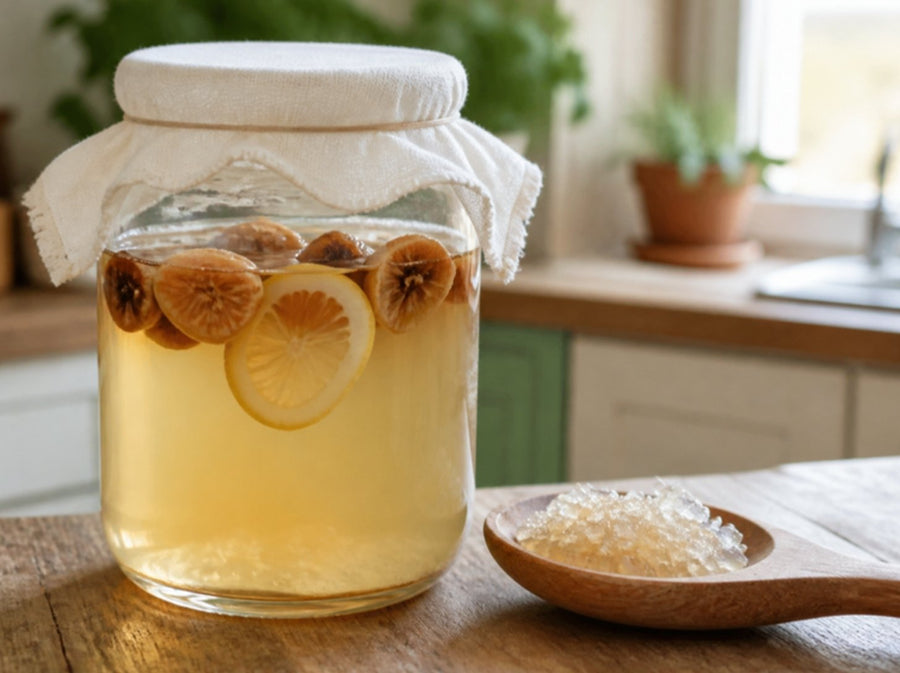
Water kefir grains are a living culture of bacteria and yeast that turn sugar water into a light, fizzy, dairy-free probiotic drink, a bit like a dry, slightly fizzy lemonade. Your grains have travelled to you, so they need a few brews to wake up and settle in. Read these instructions through before you start, and get in touch if you're unsure about anything.
At a glance
| Sachet | Grains | Water | Sugar | Also add |
|---|---|---|---|---|
| Small | 25g | 500ml | 35–40g | 2 tsp dried fruit |
| Standard | 45g | 750ml–1 litre | 65–70g | 2 tsp dried fruit |
| Family | 80g | 2 litres | 100–140g | 2 tsp dried fruit |
For your first 3 to 5 brews, use only 500ml of water (with the sugar scaled down to match), whatever size sachet you have. Each brew takes 24 to 72 hours. Always brew with a breathable cover, never a sealed lid.
Before you begin
Chlorine-free water
Chlorine harms your grains. Use filtered or spring water, or boil tap water and let it cool.
Brew open, not sealed
Water kefir makes a lot of gas. Always brew under a cloth or paper cover, never a sealed lid, or the jar can burst.
Keep cultures apart
Keep different cultures at least 1 metre apart, ideally in separate rooms, to stop cross-contamination.
Use glass jars and plastic sieves and spoons, and keep metal away from your grains. Wash and rinse your jar and utensils well. They don't need sterilising.
What you'll need
- Your water kefir grains
- Chlorine-free water (see the table for how much)
- Plain sugar: white or organic cane sugar works best (see choosing your sugar)
- 2 teaspoons of unsulphured dried fruit, such as raisins, apricots or organic figs
- A slice of lemon and a slice of fresh ginger (optional, for minerals)
- A glass jar, such as our 1 litre glass jar
- A plastic sieve and spoon, like our plastic sieve
- A cloth or paper cover and an elastic band
- Pressure-safe bottles, such as our fermenting bottles or PET bottles
Starting from scratch? Our water kefir starter kit has everything you need in one go.
Your first brew, step by step

-
Make the sugar water
Dissolve the sugar in a little warm water, then top up with cool chlorine-free water. Make sure it's at room temperature before the grains go in, never warm.
-
Add the grains and fruit
Pour the sugar water into your glass jar, then add your grains, 2 teaspoons of dried fruit, and a slice of lemon and ginger if you like. These aren't for flavour: they add minerals that keep your grains healthy.
-
Cover it
Cover the jar with a cloth or paper cover and secure it with an elastic band. Never seal it with a lid.
-
Leave it to brew
Leave it at room temperature, out of direct sunlight, for 24 to 72 hours.
-
Strain and start again
Strain out the grains with a plastic sieve, throw away the fruit, and put the grains straight into fresh sugar water to start the next brew.
Never add flavourings to the first brew while the grains are in it. Flavour your kefir afterwards, in the bottle (see second ferment and flavouring).
How to tell it's working
- Colour: the liquid changes colour. With white sugar it turns from yellowish to a cloudier, more opal colour. With darker sugars it turns a lighter shade of brown.
- Taste: it should be less sweet than the sugar water you started with. It will still taste a little sweet, as it contains natural fruit sugar (fructose).
- Smell: it may smell a little vinegary or yeasty. That's normal.
- You may see small bubbles.

This is what ready looks like. The brew has turned cloudy, and the grains and dried fruit have floated up to the top. If it still looks clear and the fruit is sitting on the bottom, give it a little longer.
The first few brews may be flat or taste odd while your grains settle in. Once they're brewing well, build up to the full amount of water for your sachet size. The taste and how active your grains are can keep changing for the first 6 to 8 weeks. That's normal for a live culture.
Open or closed brewing?
Always brew water kefir open, with a cloth or paper cover held on with an elastic band. Water kefir makes a lot of gas, and a sealed jar can build up enough pressure to explode.
If you'd prefer a closed brew, only use a lid with an airlock, such as our fermentation lid with airlock, ideally one that can pop off if the pressure gets too high. The fizz comes later, in the bottle.
Choosing your sugar
The sugar is your grains' food. It's partly personal preference, but always read the label and use a plain sugar with no added ingredients such as anti-caking agents.
| Sugar | Use it? | What you'll get |
|---|---|---|
| White sugar | Yes | A sweet, neutral-tasting, nicely fizzy kefir. Ideal if you want to flavour it. |
| Organic cane sugar | Yes, our favourite | The most popular choice. A sweet-ish, fizzy kefir that's good for flavouring. |
| Turbinado or raw sugar | Yes | A drier, less sweet kefir, and it can be harder to get a good fizz. |
| Rapadura, sucanat or brown sugar | Yes | A richer, stronger-tasting kefir. The grains love the minerals and often grow faster. An acquired taste for some. |
| Molasses | Only as an extra | Up to ½ teaspoon per batch alongside cane sugar, for minerals. Never on its own. |
| Coconut sugar or maple syrup | Only occasionally | Too rich on their own and can damage the grains. Only a little, mixed with cane sugar, now and then. |
| Honey | Never | Raw honey has its own bacteria that compete with your grains. It's not worth the risk. |
| Sweeteners (stevia, agave, monk fruit, sucralose) | Never in the brew | They aren't sugar, so your grains can't feed on them, and mould is very likely. You can add them to the bottle after brewing, for sweetness. |
For more, see our blog on types of sugar for water kefir.
Second ferment and flavouring
The second ferment, in sealed bottles once the grains are out, is where your water kefir gets its fizz and its flavour. Because the grains are already out, you can experiment as much as you like. Keep a note of what you try, so you can repeat the ones you love.

-
Add your flavour to the bottle
Fill about a third of each bottle with fruit juice, or add chopped fresh or dried fruit, fruit tea (cooled), a cordial such as ginger, or herbs and spices. Avoid cloudy juices, as they can make stringy bits.
-
Top up with kefir
Top up with your strained water kefir, leaving a little space at the top, and seal the bottle.
-
Leave it to fizz
Leave the bottles at room temperature. Somewhere warm (around 22°C) they're usually ready in 1 to 3 days. Somewhere cooler it can take a week or more. Burp them daily (see below).
-
Chill and enjoy
When it tastes mildly sweet but mostly tart, move it to the fridge. It tastes best chilled.
Flavour ideas (per 500ml bottle)
Lemonade or limeade
½ tbsp fresh lemon juice and/or ½ tbsp lime juice.
Blueberry lemonade
3 to 5 blueberries, fresh or frozen, and ½ tbsp lemon juice.
Strawberry and kiwi
2 to 4 strawberries, ½ a kiwi and ½ tbsp lemon juice.
Citrus berry blast
A few blueberries, raspberries, blackberries and chopped strawberries, ½ tbsp lemon or lime juice, and a little elderberry cordial.
Tropical
¾ tbsp each of pineapple, orange and lime juice. Stir in some coconut milk when serving for a creamy treat.
Ice lollies
Any of these can be frozen in ice lolly moulds. Perfect on a hot day.
More recipes: 4 refreshing water kefir recipes and elderflower and ginger water kefir.
Bottling and fizz safely
Water kefir builds up a lot of pressure in the bottle. The more sugar (including fruit and juice) and the warmer it is, the more gas it makes.
- Use proper fermenting bottles or PET bottles that are heavy for their size, with strong wire clips and a snug, flexible seal. Never re-use wine bottles or ordinary glass bottles, and remember not all swing-top bottles are made for pressure.
- Clean your bottles as soon as they're empty: rinse out the sediment, wash in hot soapy water (a bottle brush helps), rinse several times and leave them upside down to dry. No bleach, and no need to sterilise.
- Check every bottle for cracks, chips or flaws each time, and throw away any that are damaged. Check the rubber seals on swing tops every few months and replace the tops if they look perished. Re-use PET bottles until they no longer seal or they split.
- Burp your bottles once a day at room temperature, and more often above 24°C. Once they're in the fridge, burp them weekly.
- Keep fermenting bottles in a box or a supermarket cool bag. It won't stop a bottle bursting, but it will contain the mess.
- Open bottles slowly over the sink, with a plastic jug handy to pop over the top if it fountains.
- If a full bottle hasn't been burped for a while, take it outside, wrap it in a tea towel, point it away from faces, and open it slowly.

See our full guide to cleaning, checking and burping your bottles.
Want more fizz? See our guide to getting fizz: the best bottles, how much sugar to add, why it might be flat, and how to stop it gushing.
Looking after your grains
Your grains are a little self-contained ecosystem. Keep them fed, warm enough and with the right amount of sugar water, and they'll look after themselves.
Keep the ratio right
- Aim for about 3 to 4 heaped tablespoons of grains to 1 litre of water and 65 to 70g of sugar. Once settled, that's usually ready in about 24 hours.
- Your grains grow as you brew. More grains means more sugar water, and you'll soon be making more kefir than you can drink, so keep to about 3 to 4 tablespoons per litre you want.
Signs you have too many grains
- Your kefir is ready much faster than usual (although a warm room can do this too).
- It's very sour and vinegary.
- It's a little slimy.
- Your grains are getting smaller.
What to do
- Take some grains out, back to about 3 to 4 tablespoons per litre.
- Keep some spares as back-ups, just in case (see taking a break).
- Share them with friends, or start a second jar.
Washing your jar
There are lots of opinions on this. Our favourite: keep re-using the same jar between batches without rinsing, and give it a good clean every week or so. If you use washing-up liquid or vinegar, rinse the jar really well afterwards, and let a hot jar cool completely before your grains go back in. Never use bleach.
Rinsing your grains
Don't rinse your grains as a routine. They coat themselves in a sticky layer that protects them. The only time to rinse them is when you starve them (below), and always in unchlorinated water: boiled and cooled, or filtered.
Starving your grains (every 3 to 6 months)
Over time your grains can pick up stray bacteria from your kitchen and become a little unbalanced. Starving them rebalances them.
-
Rinse them
Gently rinse the grains in unchlorinated water (boiled and cooled, or filtered).
-
Put them in water
Put them in a jar or glass with about 200ml of unchlorinated or filtered water, and cover with a cloth as normal.
-
Leave them for 24 to 48 hours
We usually go for 24 to 36 hours.
-
Back into sugar water
Strain them and put them back into fresh sugar water. Brew as normal.
Spare grains can also be used to make a sourdough starter.
Taking a break
- Up to 2 to 3 weeks: put your grains in fresh sugar water, seal the jar with a lid and keep it in the fridge. The cold slows them right down, so a lid is fine in the fridge.
- Longer: change the sugar water every 2 to 3 weeks.
- When you're back, strain them into fresh sugar water at room temperature. They may need a brew or two to get going again.
Keeping a back-up set of grains
Once your grains are growing well, it's a good idea to keep a back-up set, dried or frozen. Then if anything happens to your grains, you just grab your spares. Both methods keep grains for about 12 months. After that, the chance of them waking up again starts to drop, so replace your back-up every year.
You'll need 3 freshly washed tea towels, ironed with a really hot iron to make sure they're clean (or greaseproof paper), and a zip-lock freezer bag.
To dry your grains
-
Rinse them
Give some spare grains a really good rinse in filtered or unchlorinated water.
-
Pat them dry
Put them in one of the tea towels and gently squeeze out as much moisture as you can. Be gentle, so you don't squash or damage them.
-
Spread them out
Lay a second tea towel on a plate or tray, spread the grains out as thinly as you can, breaking up any clusters, and cover them with the third tea towel.
-
Leave them to dry
Leave them somewhere clean and quiet, away from the kitchen and laundry (or in a cupboard), at normal room temperature. Water kefir grains take 3 to 5 days, and look rather like brown sugar or sand when they're dry.
-
Store them
Put them in a zip-lock bag, squeeze out as much air as you can and keep them somewhere cool and dry.
To freeze your grains
-
Rinse, pat dry and spread out
Follow the first 3 steps for drying, above.
-
Dry them slightly
Leave them for 12 to 24 hours. This stops ice crystals damaging the grains when they freeze.
-
Freeze them
Put them in a zip-lock bag, seal it and pop it in the freezer.
To use your back-up grains, defrost frozen grains and brew as normal. Wake dried grains up just like our dehydrated grains, following how to rehydrate kefir grains. Either way, they may need a few brews to get going again, just like new grains.
No spares yet? Our dehydrated water kefir grains keep for months and come with their own activation instructions.
How much to drink
Water kefir is full of live bacteria and yeasts, so start gently and let your body adjust.
Some people get wind, bloating or changes in toilet habits at first. Cutting back for a while usually settles it.
Good to know: water kefir is a fermented drink, so it contains a little alcohol, generally around 0.5 to 1.5%. Bear this in mind if you're sensitive to alcohol or giving it to children, and dilute it with spring water if you like. Check with your doctor first if you're pregnant, have a weakened immune system or take regular medication.
Is it mould?
Normal
- Cloudy liquid and sediment at the bottom.
- Grains changing colour with the sugar and fruit you use.
- A yeasty or slightly vinegary smell.
- Bubbles, and a little foam on top.
Mould
- Fuzzy, furry spots on the surface, the fruit or the grains.
- Pink, green, blue or black patches.
- If you're not sure, treat it as mould.
Mould is more likely if you use sweeteners instead of sugar, chlorinated water, or a cold room, or if cultures are kept too close together.
Think it's mould? First check our Culture Clinic and Help Hub.
Bought the grains from us recently and want a replacement? Don't throw them away. Cover the jar, don't drink it, and send us a photo so we can see it and help. We can't replace grains that have already been thrown away.
Otherwise, if it's mould, throw away the brew and the grains, wash everything in hot soapy water and start again.
Troubleshooting
Answer a couple of quick questions to find out what's going on.
Frequently asked questions
I've left my new grains for 24 hours and nothing has happened. Are they dead?
No, they're just settling in. The journey is a big upheaval for live grains, and all grains take a little while to adjust. Use only 500ml of sugar water for the first few brews and change it regularly. It can take a few brews before they work reliably.
The little sachet has leaked. Are my grains ruined?
No. Live grains carry on fermenting in the post, so the little sachet can sometimes leak or even burst. It's heat-sealed inside a larger bag to protect it, and the grains will brew as normal.
How do I know when my water kefir is ready?
When it tastes less sweet than the sugar water you started with, has changed colour slightly and smells a little vinegary or yeasty. See how to tell it's working.
Why isn't my water kefir fizzy?
The fizz comes from the second ferment in sealed bottles, not the first brew. Add a little fruit juice or fruit to the bottle, seal it and leave it somewhere warm for a day or two longer.
Can I use honey or sweeteners?
Never in the brew. Honey has its own bacteria, and sweeteners can't feed your grains, so mould is likely. Sweeteners can be added to the bottle after brewing. See choosing your sugar.
Can I seal my jar with a lid?
Not a normal lid. Water kefir makes a lot of gas and a sealed jar can explode. Use a cloth cover, or a lid with an airlock. See open or closed brewing.
How do I store my finished water kefir?
In the fridge for 7 to 10 days, or at room temperature for 3 to 5 days. It tastes best chilled. Remember to burp sealed bottles.
Does water kefir contain alcohol?
A little, generally around 0.5 to 1.5%. Bear it in mind if you're sensitive to alcohol or giving it to children.
Is water kefir halal?
Many Islamic scholars consider water kefir halal, because the tiny amount of alcohol (usually under 0.5% with a normal brew) is made naturally during fermentation and isn't enough to intoxicate, in the same way as vinegar or bread. Some are more cautious about home brews, as the alcohol level can vary and rises with longer brews and long second ferments. Our grains aren't halal certified, so if you're unsure, please check with your imam or a scholar you trust. Keeping your brews short and chilling your bottles promptly helps keep the alcohol low.
Is water kefir kosher?
Water kefir is made from sugar, water, fruit and the grains, with no meat or dairy. However, our grains aren't kosher certified. If keeping kosher is important to you, please check with your rabbi or kosher authority.
What's the difference between water kefir and milk kefir?
Water kefir is dairy-free and brewed with sugar water, making a light, fizzy drink. Milk kefir is brewed with milk and makes a thick, tangy, yoghurt-like drink. They're different cultures, so the grains aren't interchangeable. See our milk kefir guide.
Troubleshooter
Different culture? Visit the Culture Clinic. Still stuck? Get in touch.
Still stuck?
Every culture behaves a little differently. Send us a message, with a photo if you can, and we'll take a look. Or book a one-to-one session and we'll help you set up your brew.
Get in touch Book brewing advice Culture ClinicReady for more?
Starting again, brewing a bigger batch, or after a fresh culture for a friend? Everything you need is in the shop.
Shop water kefirWater kefir starter kitAll brewing guides